
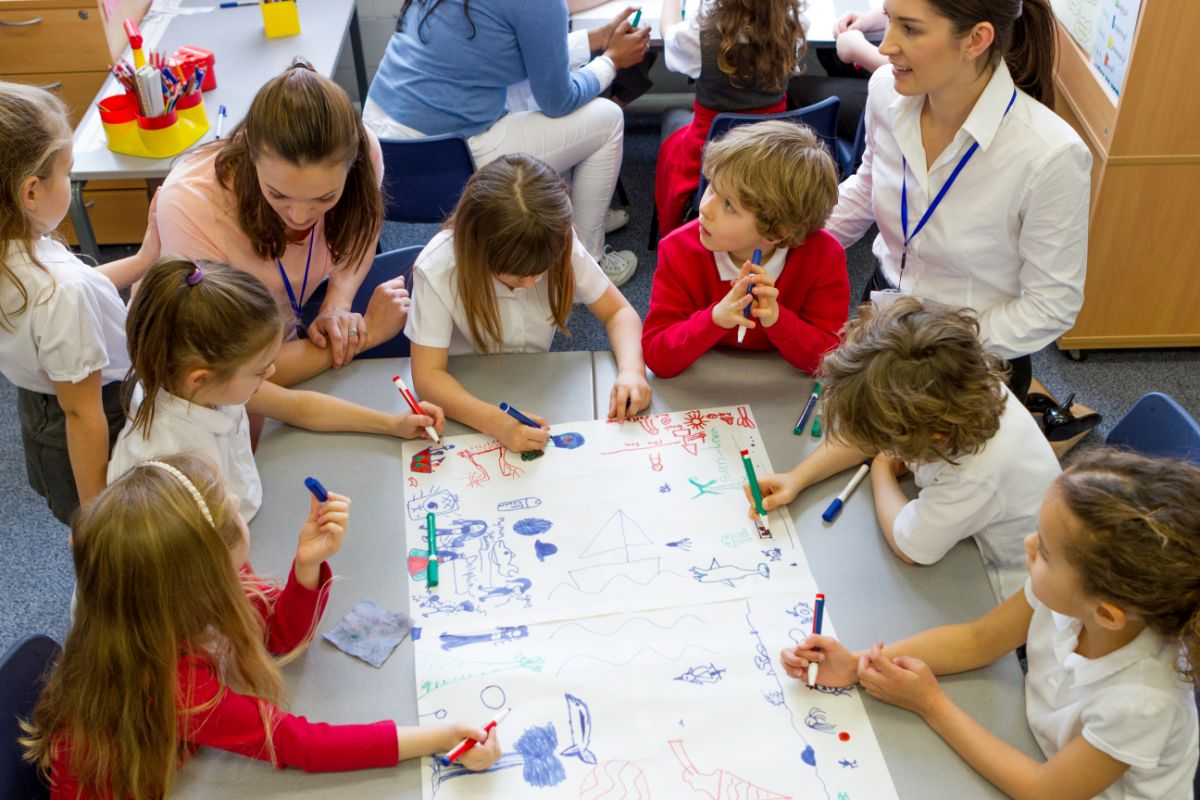
Watch a group of five-year-olds argue over a single red crayon and you are watching something more important than it first appears. Beneath the tears and the tug-of-war sits one of childhood’s most valuable lessons: how to disagree with another person and come out the other side. Conflict is not a problem to be stamped out. It is a skill to be learned, and the early years are where much of that learning quietly happens.
We tend to treat childhood squabbles as noise, something to be quietened as quickly as possible. Yet researchers who study social development take a different view. They see disagreement as a rehearsal space, a low-stakes arena where children test out fairness, negotiation and the uncomfortable business of not always getting their way.

Why smoothing things over can backfire
The instinct to intervene is understandable. A child in distress pulls hard on adult sympathy, and separating two arguing children ends the immediate upset. But when adults resolve every dispute on a child’s behalf, they remove the very friction the child needs to grow.
Developmental psychologists have long noted that children who are given room to work through minor conflicts tend to build stronger self-regulation. They learn to read the frustration in a friend’s face, to wait, to offer a compromise. These are not soft extras. They are the foundations of empathy, and empathy is difficult to teach through instruction alone. It is learned in the doing.
That does not mean adults should stand back entirely. The most useful role is closer to a coach than a referee. A well-placed question (“How do you think she felt when that happened?”) does more than a ruling ever could.
Conflict as a thinking skill
There is a tendency to file conflict under behaviour rather than learning, but the two are deeply linked. Handling a disagreement well asks a child to hold two perspectives at once: their own and someone else’s. That is cognitively demanding, and it maps neatly onto the kind of reasoning children need across the curriculum.
A child who can pause, consider another viewpoint and adjust their approach is practising the same mental flexibility that helps with problem-solving in maths or interpreting a character’s motives in a story. This is why thoughtful settings weave social skills into everyday life rather than treating them as a separate subject. Parents looking for a school where personal development is taken as seriously as academic progress often find that the two reinforce one another rather than competing for time.
Small moments, lasting habits
Much of this learning is invisible. It happens in the corridor, at the lunch table, during a shared game that briefly goes wrong. The adults nearby may barely register it, yet each of these moments adds a small deposit to a child’s growing sense of how to be with other people.
A few principles tend to make a difference:
– Naming feelings out loud helps children build the vocabulary to describe what they are experiencing rather than only acting on it.
– Modelling calm disagreement matters more than any lesson, because children copy what adults do far more readily than what they say.
– Allowing repair, the apology and the return to play, teaches that a rupture is not the end of a relationship.
None of this is dramatic. That is rather the point. Learning to handle conflict is a slow, cumulative process, built from hundreds of ordinary encounters over many years.
The long view
The children arguing over a crayon today will one day be navigating disagreements in workplaces, friendships and families of their own. The habits they form now, the willingness to listen, the ability to stay steady when things get heated, will travel with them. Seen that way, a settled playground dispute is a genuinely valuable thing.
Schools and families that understand this tend to greet conflict with patience rather than alarm. They know that the goal is not a childhood free of disagreement, which would be neither possible nor useful, but children who leave equipped to disagree well. That is a quieter kind of success, and one worth taking seriously.
—
*This article was contributed by the team at Bishopsgate School, an independent day school for children aged 3 to 13 set in the Surrey countryside near Egham. The school places equal weight on academic achievement and personal development, encouraging pupils to grow into thoughtful, resilient and considerate young people. Learn more at https://bishopsgateschool.com.*