
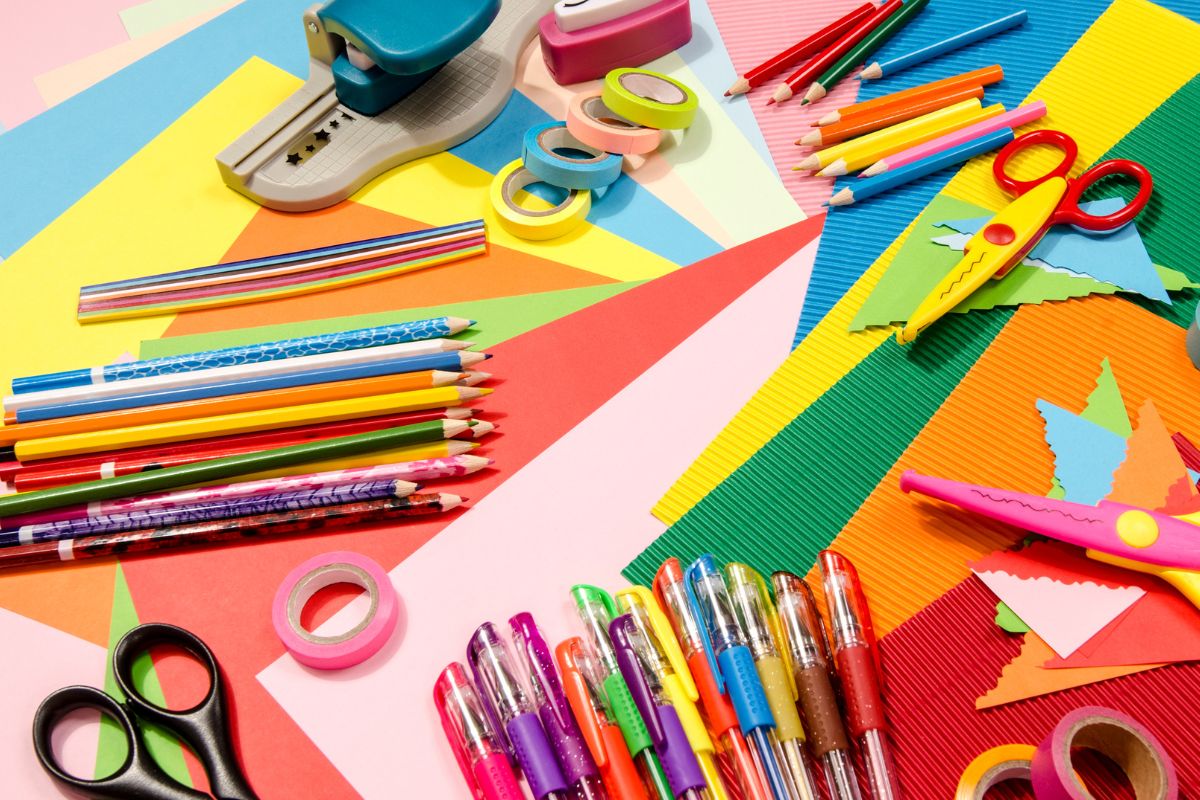
Ask most parents what they picture when they hear “arts and crafts” and the answer tends to be glitter on the kitchen floor. Fun, yes. Educational, maybe. But the idea that folding paper or mixing paint could shape how a child thinks? That takes a bit more convincing.
Here is the short version: it can, and it does. What looks like a messy afternoon is often quiet, meaningful work happening in a young brain.

So what do we actually mean by arts and crafts?
The phrase covers a wide range. Drawing, painting, collage, pottery, model-making, textiles, printmaking. Anything that asks a child to make something with their hands and a bit of imagination usually counts.
The common thread is that there is no single correct answer. A maths problem has one solution. A clay pot can take a hundred shapes, and every one of them is valid. That open-endedness is the whole point.
The thinking behind the making
When a child decides how to build a cardboard castle, they are planning, predicting and problem-solving. If a wall keeps collapsing, they have to work out why and try again. That loop of attempt, failure and adjustment is exactly how resilience is built, and it feels far less daunting with a glue stick than with a spelling test.
Fine motor skills develop too. Cutting along a line, threading a needle or gripping a brush all strengthen the small muscles children later rely on for writing. The benefits are practical as much as creative.
Confidence grows one project at a time
There is real value in finishing something and being able to say, “I made that.” For children who find reading or numbers a struggle, a craft project can be the moment they feel genuinely capable. That sense of achievement often carries across into other areas of learning.
Group projects add another layer. Sharing materials, agreeing on a plan and dividing up tasks teaches cooperation without anyone needing to spell the word out. It is teamwork disguised as fun.
Why schools take it seriously
The best educational settings understand that creative subjects are not a break from real learning but a part of it. Well-resourced schools tend to treat art rooms, kilns and design spaces as essential rather than optional, giving pupils room to experiment properly. Families looking at schools that give creative subjects genuine weight alongside academic study often notice how much confidence and independence grow as a result.
At Surbiton High School, that thinking runs through how creativity is woven into everyday learning rather than tucked away at the edges of the timetable. You can see more at https://surbitonhigh.com.
A few simple ways to encourage it at home
You do not need a studio or a shopping list of supplies. Keep a box of odds and ends, empty tubes, buttons, scraps of fabric, and let curiosity do the rest. Resist the urge to correct or tidy up too quickly. Ask what a child was trying to make rather than what it is meant to be.
Most of all, treat the process as the point. The finished object matters far less than the thinking that went into it.
Arts and crafts will never look as serious as a maths worksheet. That is precisely why it works. Behind the mess sits a young mind learning to plan, adapt, cooperate and believe in what it can create, and those are skills worth taking seriously.
—
*This article was contributed by the team at Surbiton High School, an independent day school committed to nurturing creativity, confidence and academic curiosity in every pupil. Surbiton High School champions a broad and balanced education where the arts sit comfortably alongside academic achievement, helping young people develop the practical and imaginative skills they carry with them for life.*